
The circle check, step by step
Last updated: Written by Blake Cowan, NCSO
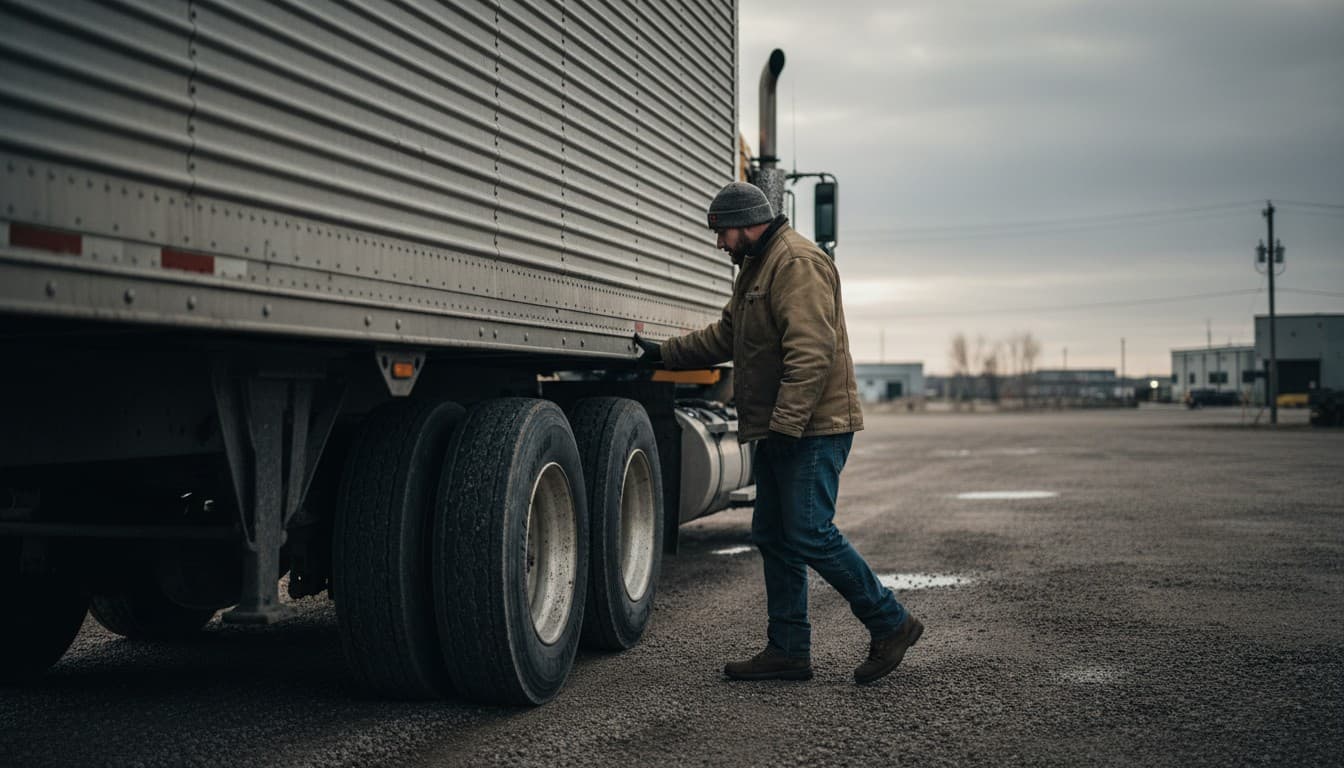
The short answer
A circle check is the daily inspection you do before driving a commercial vehicle, and it is the same requirement other provinces call a pre-trip or daily trip inspection. The regulation sets out what to inspect, not what order to do it in. Pick one route around the truck and never vary it, because a habit is what stops things being missed.
Every driver has been shown a circle check at some point. Far fewer have been shown a route, which is why so many of them wander around the truck, look at whatever catches the eye, and sign the sheet.
The regulation gives you the list of systems. It does not give you an order. That gap is where the missed items live, so this is a walk-around order that covers everything without doubling back.
Is a circle check the same as a pre-trip inspection?
Yes. Circle check, pre-trip and daily trip inspection are three names for the same legal requirement, and which one you say depends mostly on where you learned to drive.
Ontario tends to say circle check, the west tends to say pre-trip, and the regulations themselves generally say daily inspection or trip inspection. None of that changes what you have to look at, because the systems come from the inspection schedule that applies to your vehicle, and that schedule traces back to the same national standard in every province. What the law requires and how defects are classified covers the legal side in full.
Is a circle check legally required?
It is, and not just in one province. The requirement comes from National Safety Code Standard 13, the national daily vehicle trip inspection standard, which the provinces have adopted into their own regulations. The name on the door changes. The obligation does not.
Alberta requires the inspection under the Commercial Vehicle Safety Regulation, covering the items in Schedule 1 of NSC Standard 13 Part 2, on commercial vehicles and combinations registered for more than 4,500 kilograms, with the inspection valid for 24 hours from the time recorded on the report.
Saskatchewan requires every commercial vehicle, and any trailer or semi-trailer being towed, to be inspected once in every 24 hour period while in use. Note the local wrinkle: drivers there carry the completed report for both the current and the previous day, plus the applicable schedule, and must produce them for a peace officer on request.
British Columbia requires the pre-trip each day before the first trip, and on multi day trips no later than the first stop on each following day.
Ontario requires a driver to complete a vehicle inspection every 24 hour period and monitor the vehicle's condition throughout the trip, and to carry both the current inspection report and the inspection schedule, electronic versions permitted.
Common to all of them: you inspect the systems the schedule lists rather than whatever catches your eye, you keep watching the vehicle through the trip, and you report defects to the operator as soon as possible.
The walk-around, in order
Start in the cab, because that is where you are already sitting and where the air pressure tests happen. Then step out onto the driver's side and keep going in one continuous loop, finishing at the front.
That order is not arbitrary. Each station is next to the one before it, so you are never crossing the yard to look at something and then coming back.
| Station | What you are checking there |
|---|---|
| 1. In the cab, before you move | Driver controls and seat, horn, glass and mirrors, wipers and washers, heater and defroster, emergency equipment, and the brake system checks including the low air warning and pressure build up |
| 2. Driver's side of the tractor | You stepped out on this side, so start here. Steer tire and wheel fasteners, fuel system, exhaust, air lines and electrical lines, frame and body, suspension, and side lamps and reflectors |
| 3. The coupling | You have arrived at the back of the tractor and it is right in front of you. Coupling devices, the fifth wheel and locking jaws, safety chains where fitted, and the air and electrical connections between units |
| 4. Along the trailer and across the rear | Carry straight on. Trailer tires and wheels, suspension, cargo securement, rear lamps and reflectors, and the rear doors or gate |
| 5. Up the passenger side | The same running gear checks coming forward on the other side, tires, suspension, lamps and reflectors, frame and body |
| 6. The front, last | Headlamps and front lamps and reflectors, windshield, steering linkage where visible, front suspension, bumper and frame, and under the hood if your operation requires it |
Scroll the table sideways to see every column. The first column stays in place.
Source: Systems per the daily inspection schedule for trucks, tractors and trailers under Ontario Regulation 199/07 and the equivalent National Safety Code Standard 13 schedule. The stations are a way of organising the walk, not a legal sequence.
The schedule is what is authoritative. The stations above are a memory aid that maps onto it, so nothing gets skipped because you approached the truck from a different angle than yesterday.
Why the order matters more than the checklist
Here is the thing that separates a real circle check from a signed piece of paper.
When you do it the same way every morning, a missed step starts to feel wrong. You arrive at the coupling and something in the back of your mind says you have not looked at the driver side lines yet. That feeling is the whole safety mechanism, and it only exists if the route is consistent.
Vary the route and you lose it. You end up relying on the list, and reading a list while standing in the cold at six in the morning is exactly the situation where people tick without looking.
The other reason is speed, and it is why the loop runs in that direction. A driver who checks one thing on this side, then walks around to look at something on the other, then comes back, is doing the same inspection in twice the time and losing their place twice. Following the pattern is what makes it quick, and quick is what makes it actually happen on a morning when you are already late.
The parts people rush
Three areas absorb most of the findings, and all three are near the bottom of the truck where nobody wants to crouch in the wet.
Tires and wheel fasteners. Look at each one rather than glancing down the row. A loose or missing fastener and a flat tire are both out of service items, and both are visible to anybody who actually looks.
The coupling area. The fifth wheel, the jaws, the lines. It is awkward, it is dirty, and it is the connection holding your trailer on.
Air brake checks in the cab. They take a few minutes and they are the ones most often shortened, which is unfortunate given that a low air warning that stays on or a brake that does not work will take the vehicle out of service.
Knowing when to stop the truck
Finding something is not the hard part. Deciding what it means is.
A minor defect gets recorded and repaired on the normal schedule and the vehicle usually keeps working. A major defect stops the vehicle, because drivers are not permitted to drive a vehicle with a major defect until it is repaired.
The trouble is that the same system produces both. A slow air leak is minor and a brake that does not work is major. A damaged sidewall is minor and a flat is major. That is why the defect list belongs with the form, in the truck, rather than in a binder in the office. The full minor and major breakdown sets out where the line falls on the systems that come up most.
The report is the other half of the job
The walk-around protects the load. The report protects the driver.
A completed inspection, made at the time, by the person who did it, is evidence the vehicle was in that condition when you took it. That matters the day somebody asks when the damage happened, and it matters again when trip inspection records are sampled in a COR or safety fitness audit, because an auditor can tell the difference between records made in the yard and records made at a desk on a Friday.
Same principle as why crews stop filling out safety forms: the paperwork is only worth something when it is a record of something that actually happened.
Get the form
Daily trip inspection (pre-trip)
A fill-in daily trip inspection that covers all 23 systems in the National Safety Code schedule, and carries the minor and major defect list with it.
Direct download. No email needed, no signup.
Free, no email required, covering every system in the schedule with the minor and major defect list on it, so a driver can classify what they find without leaving the truck. The rest of the template library is on the same terms, and in the app the same daily trip inspections are completed in the cab with the defect routed straight to whoever fixes it.
Questions people ask about this
What is a circle check?
Is a circle check the same as a pre-trip inspection?
How long does a circle check take?
What order should you do a circle check in?
Do you have to carry the circle check report in the truck?
Is a circle check required in Alberta, BC and Saskatchewan?
What happens if you find a major defect on a circle check?
The order is the part a new driver does not arrive with
We write the inspection into your program so every driver runs the same route and the same defect list, and that is the paid half. The app is free, and in it the check is completed in the cab with the defect sent to whoever fixes it. Print the form above and teach the order at a toolbox meeting instead, which costs nothing.